Our philosophy
Calm first. Then the work.
Most recovery starts by asking people to think differently. In my experience, the body has to feel safe before the mind will listen.
In early sobriety my mind was crippled with fear and anxiety, and so was my body. I didn’t see them as the same thing back then. I do now. Your nervous system shows up in both, and if you only work on the thoughts, the other half is still running the show.
If you’ve tried to stop by willpower alone, you’ll know how it goes. A few good days. A bad one. Then a voice that sounds very reasonable telling you one won’t hurt. It’s easy to call that weakness. I don’t think it is.
The fix, not the problem
For a lot of people, the drink or the drug was never really the problem. It was the fix. A way to calm a system that wouldn’t calm down, take the edge off something painful, or fill a gap nothing else seemed to reach.
For me it started at 12. For as long as I can remember I’d been scared of the world. The first time I drank and took drugs, I actually hated it. But the feeling. It was like I could finally breathe again. I say again, but if I’m honest, I don’t think I’d ever had a proper breath in my whole life.
It was like I could finally breathe. I don’t think I’d ever had a proper breath in my whole life.
When your body has been in survival mode for years, through stress, trauma, burnout or just a life that never slows, it forgets how to come down on its own. Substances do it for you. They’re fast and they work. So when you take them away, the body is left with all that alarm and nowhere to put it. No wonder “just stop” rarely holds.
This isn’t just my opinion. Stress is one of the most studied triggers in addiction. A Yale review of the research found that stress raises the risk of addiction in the first place, makes relapse more likely afterwards, and that heavy use itself rewires the brain’s stress systems (Sinha, 2008). It often starts early, too. In the ACE study of more than 9,500 adults, people with four or more difficult childhood experiences had between four and twelve times the risk of alcoholism, drug abuse, depression and suicide attempts (Felitti et al., 1998).

Why insight alone isn’t enough
Plenty of people can explain exactly why they drink. They’ve read the books, done the therapy, understood their childhood. And they still pour the glass. Understanding why rarely changes much while the body is still braced for danger. You can’t think your way out of a state your nervous system is stuck in.
I saw this for years working in rehabs and on detox units. The same approach was put on everyone, and nearly all the attention went on the behaviour and the substance. What kept getting missed was the body, and whatever the person was running from.
What changed it for me
For me it was movement. We don’t move forward by staying still, and I had to learn that with my body before I could learn it anywhere else. Adding movement to the way I live, and pushing through fear instead of hiding from it, was key.
Training became a huge part of my life. I set times I’d go to the gym and I stuck to them. That sounds small. It wasn’t. I’d spent a life breaking promises, to other people and to myself, and every session I turned up to was one I kept.
I spent a life breaking promises. The gym slowly rewired my brain into showing up for myself.
It taught me discipline. It was also the one place my mind stopped. I focused on me, and the worries disappeared for a while.
The research is more cautious than I am, which is fair. A review in the American Journal of Drug and Alcohol Abuse found exercise may be an effective addition to addiction treatment, with a near-universal safety record, though the studies so far are mixed and the authors say more work is needed (Linke and Ussher, 2015).
Later came cold water, breathwork and time in the ocean. All three brought presence back into my life. On breathing, a Stanford trial found five minutes a day of slow, exhale-focused breathing for a month improved mood and lowered breathing rate more than the same time spent meditating (Balban et al., 2023). Cold water is less well studied. In one small trial, an hour sitting in 14°C water raised noradrenaline by 530% and dopamine by 250% (Šrámek et al., 2000). That’s a lot longer than a few minutes in an ice bath, so I wouldn’t lean on the numbers. I just know what it does for me. It brings me straight back to the present.
There’s no one way to calm down
What I’ve learned from years of helping people is that this is different for everyone. The gym was mine. For someone else it’s the ocean, or sleep, or a hard conversation, or simply a slower day. That’s why NAWA isn’t built on a cookie-cutter approach. I don’t believe in one.
What I do believe in is a safe space. Give people that, and they find their own way of settling their nervous system. On an isolated island, with nowhere to be and nothing to chase, I can’t think of a better place to find it.
So the first week is for the body
The first week at NAWA isn’t about digging into the past. It’s about giving the body something it hasn’t had in a long time: rhythm and safety. Breathwork in the morning. An ice bath if you want one. The ocean every day. The gym. Proper sleep. Food that’s cooked fresh. Time in nature with nowhere to be.
None of that is a cure. It’s groundwork. When the body starts to settle, people find they can sit with things that used to send them straight for a drink. That’s when the deeper work becomes possible.

Then the work
From week two the focus shifts to the root: not the substance or the behaviour, but the moment you stopped feeling whole and started looking outside yourself to fill it. One-to-one sessions every day. A small group of four, so nobody gets lost. Peer support from people who know this ground from the inside. A therapist and psychiatrist online.
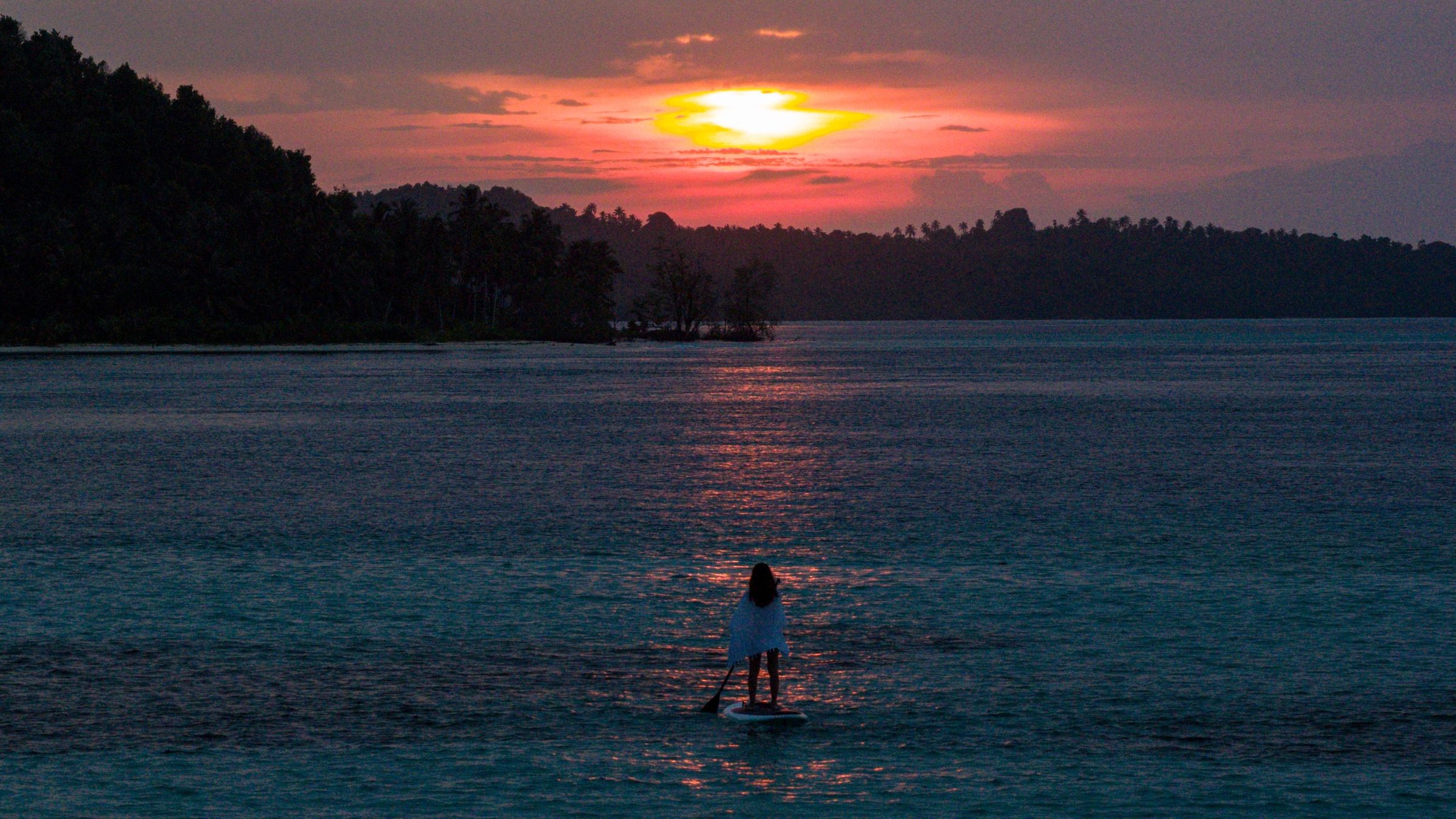
And the island does its own part. The weather changes, the sea changes, and you learn to take things as they come. I suspect the most important moment of the month won’t be in a session at all. It’ll be sitting alone on the beach at sunset and realising you’re fine without anything.
It has to work at home
The aim isn’t a perfect month on an island. It’s leaving able to settle your own nervous system without reaching for anything, with a plan for home and 60 days of follow-up calls. Read our full philosophy, or see how the four weeks work.
Sources
- Sinha R. Chronic stress, drug use, and vulnerability to addiction. Annals of the New York Academy of Sciences, 2008.
- Felitti VJ et al. Relationship of childhood abuse and household dysfunction to many of the leading causes of death in adults: the Adverse Childhood Experiences (ACE) Study. American Journal of Preventive Medicine, 1998.
- Linke SE, Ussher M. Exercise-based treatments for substance use disorders: evidence, theory, and practicality. American Journal of Drug and Alcohol Abuse, 2015.
- Balban MY et al. Brief structured respiration practices enhance mood and reduce physiological arousal. Cell Reports Medicine, 2023.
- Šrámek P et al. Human physiological responses to immersion into water of different temperatures. European Journal of Applied Physiology, 2000.
Questions
Why doesn't willpower alone work for quitting alcohol or drugs?
When the body has been in survival mode for a long time, substances become the way it calms down. Removing them without giving the nervous system another way to settle often leaves overwhelming stress, which drives relapse.
What does 'calm first' mean at NAWA?
The first week focuses on rhythm and safety for the body: breathwork, cold water, the ocean, sleep and fresh food. Deeper one-to-one and group work builds from week two.
Is NAWA a rehab?
No. NAWA is a four-week sober retreat for people who are medically stable or have completed detox, built on lived-experience peer support with a therapist and psychiatrist online.
Last updated 4 November 2026
More guides



Free PDF guide · 17 pages
Download the programme guide.
Read it first, in your own time: Rick’s story, the island, the four weeks, surf, what’s included and who it’s for. Pop your email in and the download opens straight away. No call, no pressure.
It starts with a conversation.
Book a free call →A private, confidential call with Rick himself. Just a relaxed, honest chat about where you’re at.
or email hello@nawarecovery.com · WhatsApp +62 851 9075 3013